

Courses, Trainings and Certificates Details
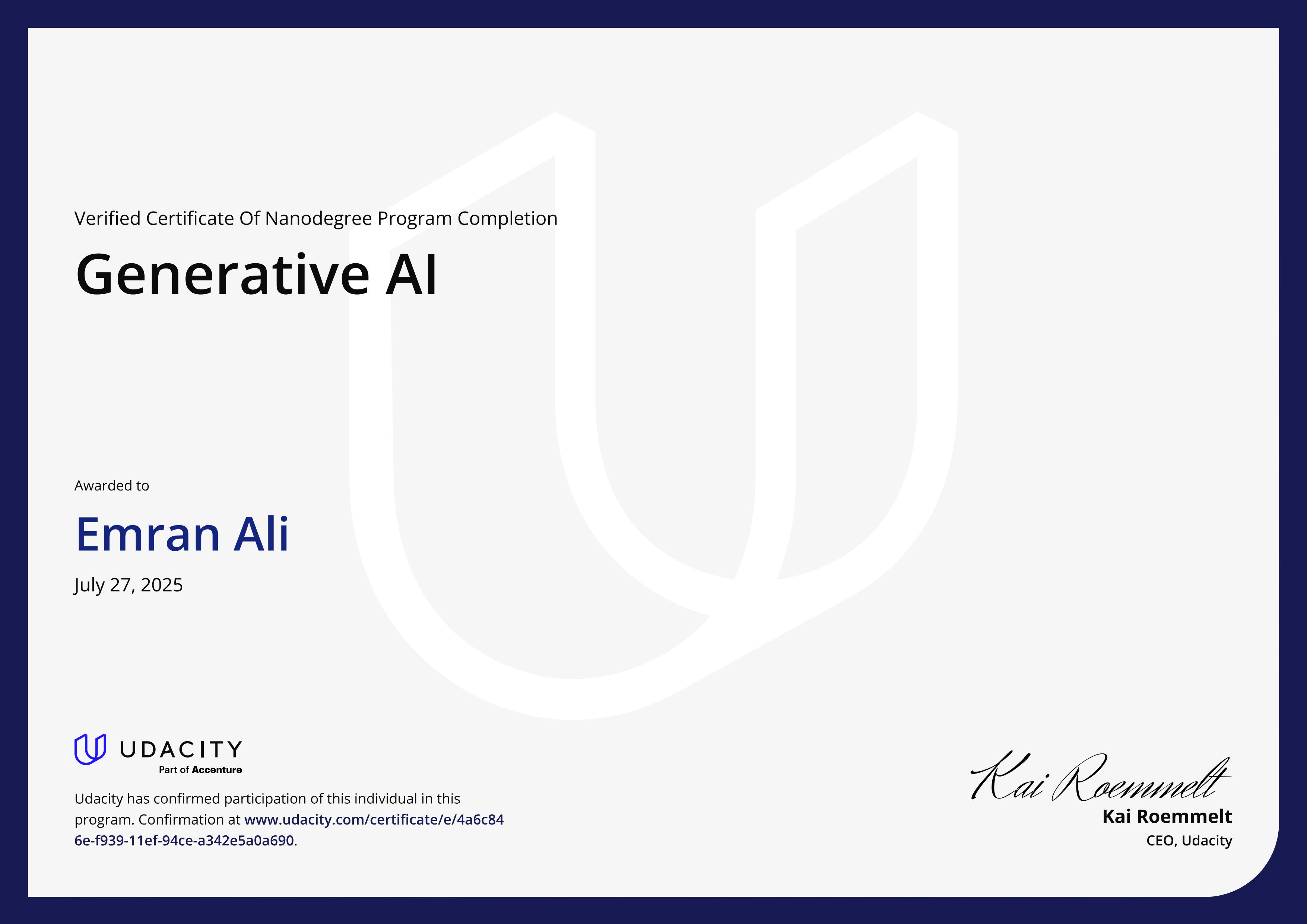
Bertelsmann Udacity - Generative AI (Nanodegree)
Type: All, Certificate, Training, Course
Description:
This Nanodegree program provides an in‑depth exploration of Deep Learning (DL) and Generative AI (GenAI), focusing on their modern applications in text and image generation. It covers foundational and advanced concepts including Large Language Models (LLMs), Retrieval-Augmented Generation (RAG), Generative Adversarial Networks (GANs), and Diffusion Models.
Throughout the program, learners work with industry-standard tools such as PyTorch, Hugging Face, LangChain, ChatGPT, and Vector Databases (e.g., LanceDB) to design, implement, and optimise generative AI systems. The practical assignments develop hands-on proficiency in model fine‑tuning, prompt engineering, vector search integration, and end‑to‑end GenAI pipeline development, equipping participants with skills aligned with current industry expectations.
https://www.udacity.com/enrollment/nd608-bmann-nextgen
Offering Organisation: Udacity
Funding Organisation: Bertelsmann
Key Information:
- Generative AI (Nanodegree by Udacity)
- Funded by Bertelsmann through Next Generation Tech Booster Scholarship (Phase 2 - Summer 2025)
- Among a few chosen students of 500 out of 27,000.
- Worth more than $5,000.
- 8 months duration, 4 online courses, regular community sessions.
- Knowledge gained: Deep Learning (DL), Generative AI (GenAI), Large Language Model (LLM), Retrieval-Augmented Generation (RAG), Chat GPT, Lowe Rank Adaptation (LoRA), Generative Adversarial Network (GAN), Diffusion Models (Stable Diffusion), Prompt Design, PyTorch, Hugging Face, ChatGPT, Diffusion model, Vector DB (LanceDB) and LangChain.
- 4 projects with DL and GenAI technology with GPT, Vector DB, LangChain, Diffusion models
Date: Jul. 27, 2025
Link: https://www.udacity.com/certificate/e/4a6c846e-f939-11ef-94ce-a342e5a0a690
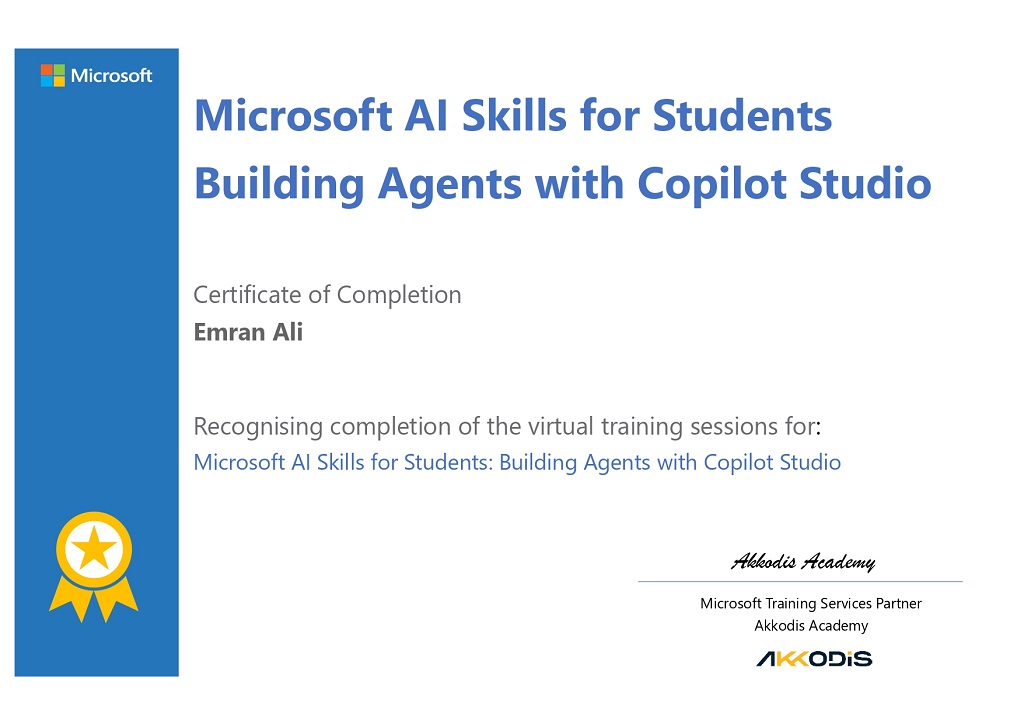
Akkodis Microsoft - Building Agents with Copilot Studio
Type: All, Certificate, Training
Description:
This comprehensive training module offers a practical and hands-on opportunity to explore the fundamental concepts of chatbots and AI agents using Microsoft’s Power Virtual Agents platform. The session guides learners through the end-to-end development of intelligent agents, including defining core data and agent concepts, configuring actions, setting up automated workflows, and designing effective prompts.
The training emphasizes how to integrate and process various knowledge sources such as websites, APIs, SharePoint, and file systems. It also delves into deploying agents effectively, allowing them to interact autonomously or semi-autonomously with users. Through detailed modules and interactive labs, learners gain valuable experience in orchestrating real-world use cases and implementing AI agents tailored to organizational needs.
https://learn.microsoft.com/en-us/training/modules/power-virtual-agents-bots/
Offering Organisation: Akkodis Academy
Funding Organisation: Deakin University
Key Information:
- Offered by Akkodis Academy in collaboration with Microsoft (Microsoft AI Skills for Student, Cohort 8, 2025)
- 1 week training + Copilot studio credit
- Microsoft Copilot Studio, Agents, Chatbot, Knowledge source, Agent templete, Actions, Automated Actions
Date: June 13, 2025
Link: https://drive.google.com/file/d/1BzuHhDXwOluq-YVpYXZZm1xwbiECEVLm/view?usp=sharing
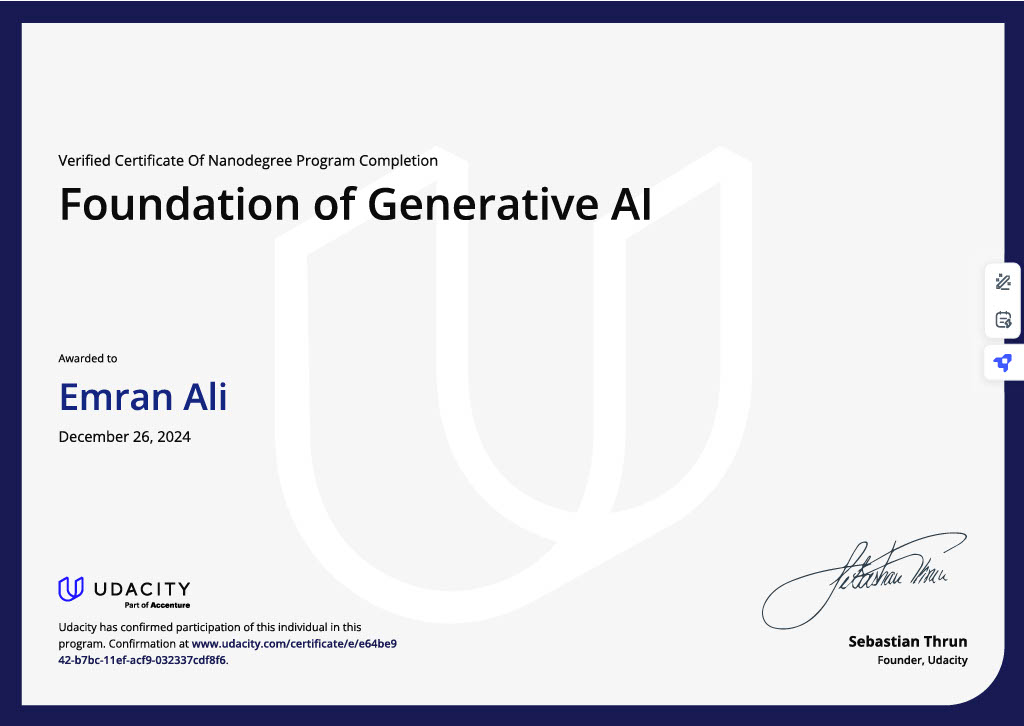
Bertelsmann Udacity - Foundation of Generative AI (Nanodegree)
Type: All, Certificate, Training, Course
Description:
This Udacity Nanodegree program offers a deep exploration of core concepts in Machine Learning (ML), Deep Learning (DL), and Generative AI (GenAI). It provides hands-on experience with the development and application of Large Language Models (LLMs), Retrieval-Augmented Generation (RAG), Autoencoders, Transfer Learning, and advanced Prompt Engineering techniques.
Throughout the program, learners work extensively with industry-standard tools and frameworks such as PyTorch and Hugging Face, developing projects that apply GenAI to real-world text and image generation tasks. The curriculum emphasizes practical implementation, helping participants build a strong foundation in both theoretical understanding and hands-on GenAI development.
https://www.udacity.com/enrollment/nd608-bmann-nextgen-challenge
Offering Organisation: Udacity
Funding Organisation: Bertelsmann
Key Information:
- Foundation of Generative AI (Nanodegree by Udacity)
- Funded by Bertelsmann through Next Generation Tech Booster Scholarship (Phase 1 - Winter 2024)
- Among a few chosen students from a challenge entrance test.
- Worth more than $1,500.
- 9 weeks duration, 2 online courses, regular community sessions.
- Knowledge gained: Machine Learning (ML), Deep Learning (DL), Generative AI (GenAI), Large Language Model (LLM), Deep Learning, Autoencoder, Transfer Learning, Retrieval-Augmented Generation (RAG), Prompt Design, PyTorch and Hugging Face.
- 1 project with DL and GenAI
Date: Dec. 27, 2024
Link: https://www.udacity.com/certificate/e/e64be942-b7bc-11ef-acf9-032337cdf8f6
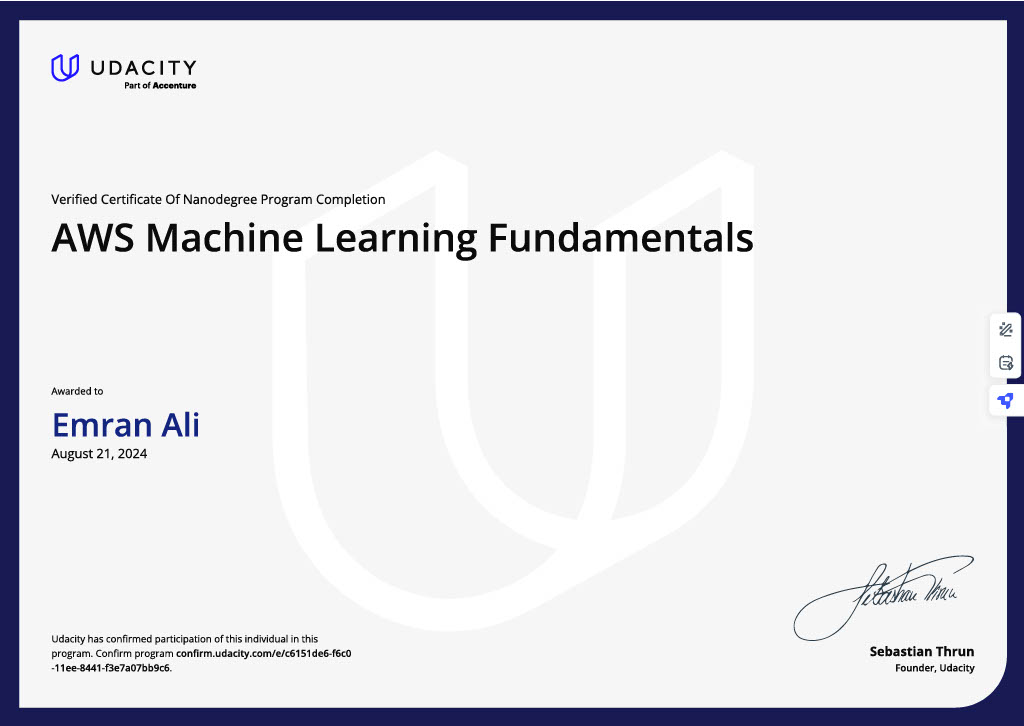
AWS Udacity - AWS Machine Learning Fundamentals (Nanodegree)
Type: All, Certificate, Training, Course
Description:
This Nanodegree program equips learners with the critical skills required to build, train, and deploy machine learning models at scale using Amazon SageMaker. The curriculum introduces foundational data science and ML concepts while offering hands-on experience with Amazon SageMaker’s advanced features—including its integrated development environment (IDE), model tuning, and production deployment tools.
Through immersive projects and real-world case studies, students learn best practices for data preprocessing, model development, automated hyperparameter tuning, and the orchestration of deployment pipelines. The program is structured to prepare professionals for real-world ML engineering roles, emphasizing scalability, automation, and operational excellence in ML systems.
https://www.udacity.com/course/aws-machine-learning-engineer-nanodegree--nd189
Offering Organisation: Udacity
Funding Organisation: Amazon Web Services (AWS)
Key Information:
- AWS Machine Learning Fundamentals (Nanodegree by Udacity)
- Funded by AWS AI/ML Scholarship (Phase 2 - Summer 2024)
- Among chosen 500 students from Scholarship Phase 1.
- Worth more than $4,000.
- 5-month duration, 4 online courses, weekly connect sessions.
- Knowledge gained: Machine Learning (ML), Deep Learning (DL), Convolutional Neural Network (CNN), ML Workflow with AWS (preprocessing to deployment automation), and related optimisation techniques using the AWS cloud platform
- 4 projects with ML, DL and AWS cloud platform
Date: Aug. 21, 2024
Link: https://www.udacity.com/certificate/e/c6151de6-f6c0-11ee-8441-f3e7a07bb9c6
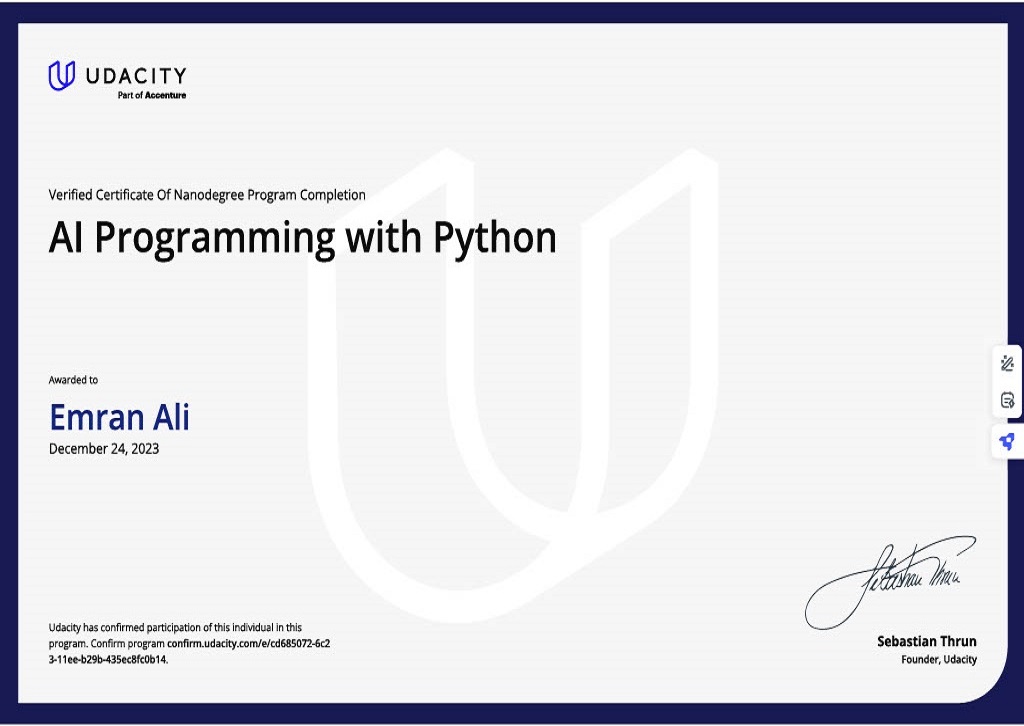
AWS Udacity - AI Programming with Python (Nanodegree)
Type: All, Certificate, Training, Course
Description:
This program provides a solid foundation in Python programming tailored for Artificial Intelligence (AI) applications. Learners will develop hands-on experience in using essential libraries such as NumPy, pandas, and Matplotlib for data analysis and visualization.
The curriculum covers the core principles of machine learning and guides students in building and training models using popular Python libraries. Through practical projects, learners implement neural networks using PyTorch, gaining exposure to deep learning techniques and workflows.
In the advanced sections, the program explores Generative AI using Transformer neural networks, covering the end-to-end process of building, training, and deploying models for natural language processing (NLP) tasks. Emphasis is placed on leveraging pre-trained models, including those available in Hugging Face and PyTorch Hub.
Designed for individuals with basic programming experience, this program acts as a bridge to more advanced studies in AI and machine learning, equipping participants with the practical skills required to begin a career in AI programming.
https://www.udacity.com/course/ai-programming-python-nanodegree--nd089
Offering Organisation: Udacity
Funding Organisation: Amazon Web Services (AWS)
Key Information:
- AI Programming with Python (Nanodegree by Udacity)
- Funded by AWS AI/ML Scholarship (Phase 1 - Winter 2023)
- Among chosen 2,000 students from the "AWS Deep Racer" challenge.
- Worth $4,000.
- 5-month duration, 6 online courses, weekly connect sessions
- Knowledge gained: Python programming, Machine Learning (ML), Deep Learning (DL); different data manipulation, visualisation, ML and DL libraries; Pytorch package for transformer and custom DL models
- 2 computer vision projects with DL
Date: Dec. 24, 2023
Link: https://www.udacity.com/certificate/e/cd685072-6c23-11ee-b29b-435ec8fc0b14
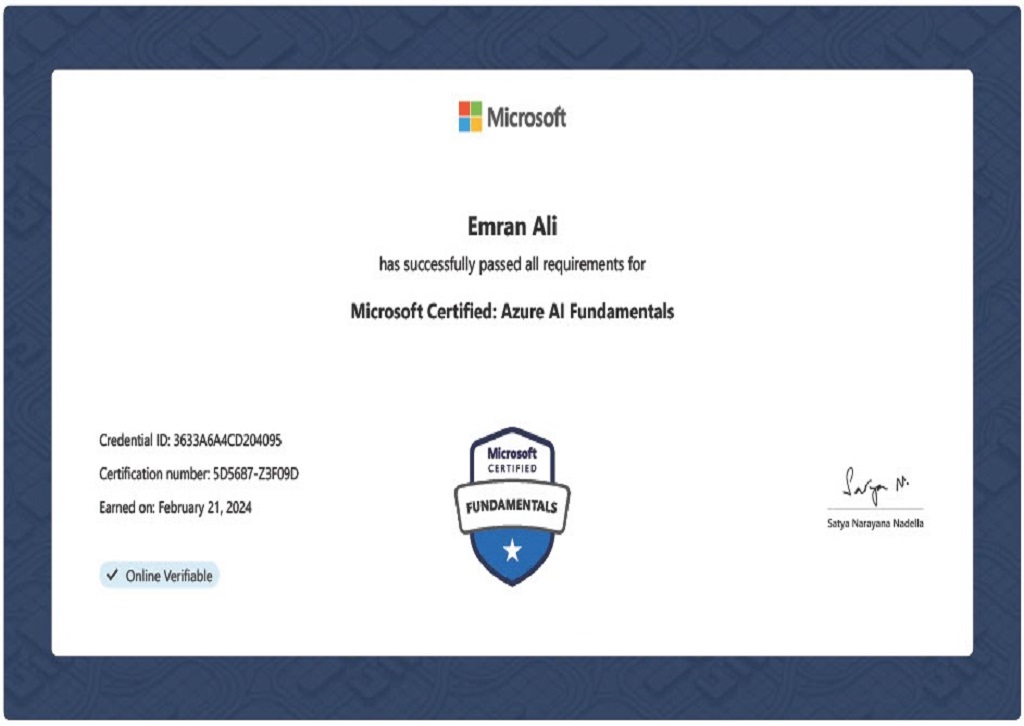
Microsoft - Microsoft Certified: Azure AI Fundamental (AI900)
Type: All, Certificate
Description:
This certification validates foundational knowledge of machine learning, artificial intelligence (AI), and associated Microsoft Azure services. It offers an opportunity for learners to demonstrate their understanding of AI concepts, regardless of their technical background.
While prior experience in data science or software engineering is not required, familiarity with basic cloud principles and client-server applications will be beneficial. Candidates are encouraged to complete the self-paced or instructor-led learning modules to prepare effectively for the certification.
Earning the Azure AI Fundamentals credential can serve as a stepping stone toward more advanced Azure role-based certifications, such as Azure Data Scientist Associate or Azure AI Engineer Associate. However, it is not a prerequisite for these.
https://learn.microsoft.com/en-us/credentials/certifications/azure-ai-fundamentals/?practice-assessment-type=certification
Offering Organisation: Microsoft
Funding Organisation: Deakin University
Key Information:
- Offered by Akkodis Academy (Microsoft Skills and Certification Bootcamp 2024)
- 2 weeks training + certificate exam voucher
- Microsoft Azure, Azure cloud platform, Azure AI, Applid ML, Generative and responsible AI
Date: Feb. 21, 2024
Link: https://learn.microsoft.com/en-us/users/emranali-5282/credentials/a7f4169ab0541879
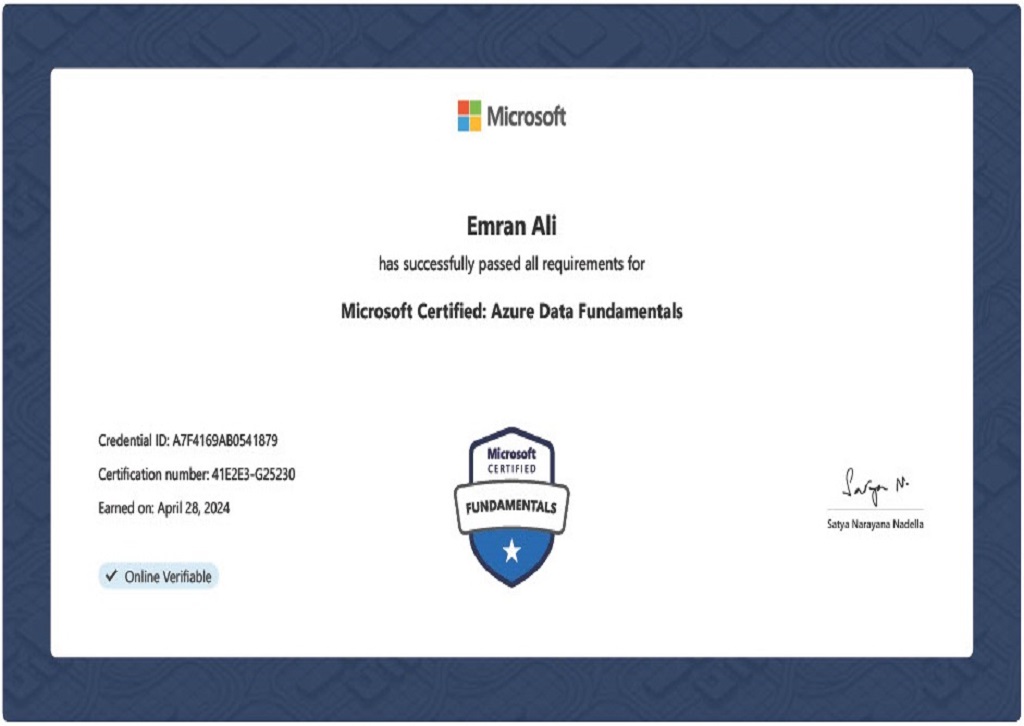
Microsoft - Microsoft Certified: Azure Data Fundamental (DP900)
Type: All, Certificate
Description:
This certification provides an opportunity to demonstrate your understanding of core data concepts and Microsoft Azure data services. It is designed for individuals beginning to work with data in cloud environments.
Familiarises with:
The fundamentals of relational and non-relational data.
Different data workloads, such as transactional and analytical processing.
This certification is ideal for candidates looking to build a foundation for further Azure role-based certifications such as Azure Database Administrator Associate or Azure Data Engineer Associate, although it is not a prerequisite for those paths.
https://learn.microsoft.com/en-us/credentials/certifications/azure-data-fundamentals/?practice-assessment-type=certification
Offering Organisation: Microsoft
Funding Organisation: Deakin University
Key Information:
- Offered by Akkodis Academy (Microsoft Skills and Certification Bootcamp 2024)
- 2 weeks training + certificate exam voucher
- Microsoft Azure, Azure cloud platform, Azure AI, Applid ML, Generative and responsible AI
Date: Apr 28, 2024
Link: https://learn.microsoft.com/en-us/users/emranali-5282/credentials/a7f4169ab0541879
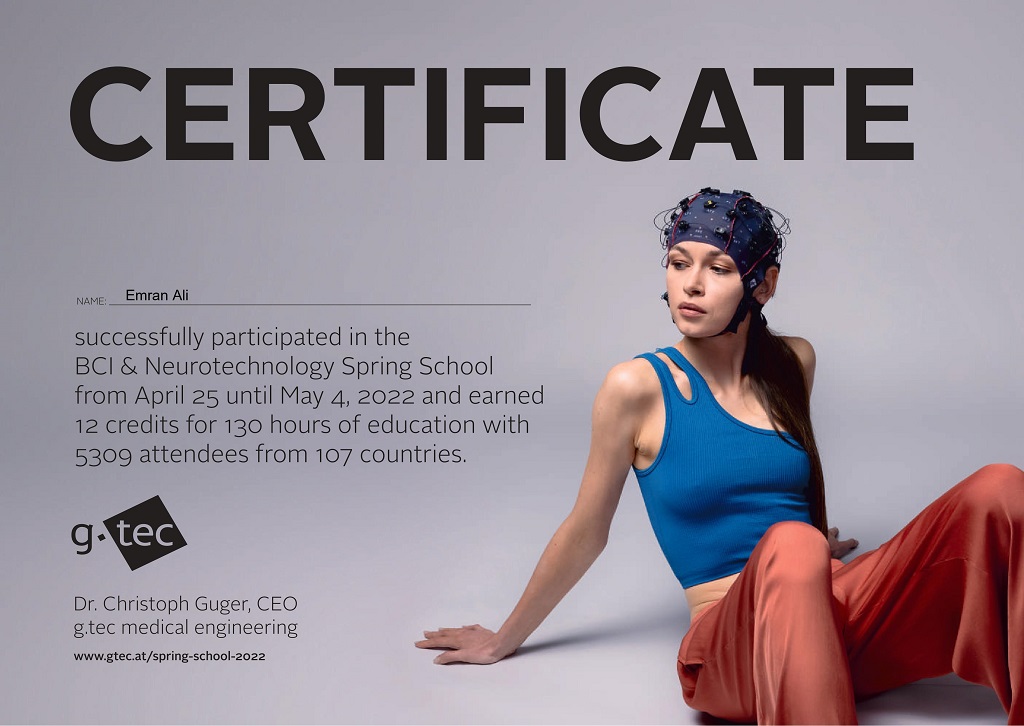
g·tec - BCI & Neurotechnology Spring School 2022
Description:
g.tec, an Austria-based company specializing in Brain-Computer Interface (BCI) hardware and software research and development, organized a 10-day international conference.
The event provided researchers with valuable insights into the latest innovations and trends in the BCI industry.
Offering Organisation: g·tec
Funding Organisation: (N/A)
Key Information:
- g·tec Neurotechnology Spring School 2022
- 10 days, 130 hours, 12 credits
- Academic and industrial topics
- Healthcare, Games, VR, Sports, Entertainment, Production, Education & Research Industries
Date: May 20, 2022
Link: (N/A)
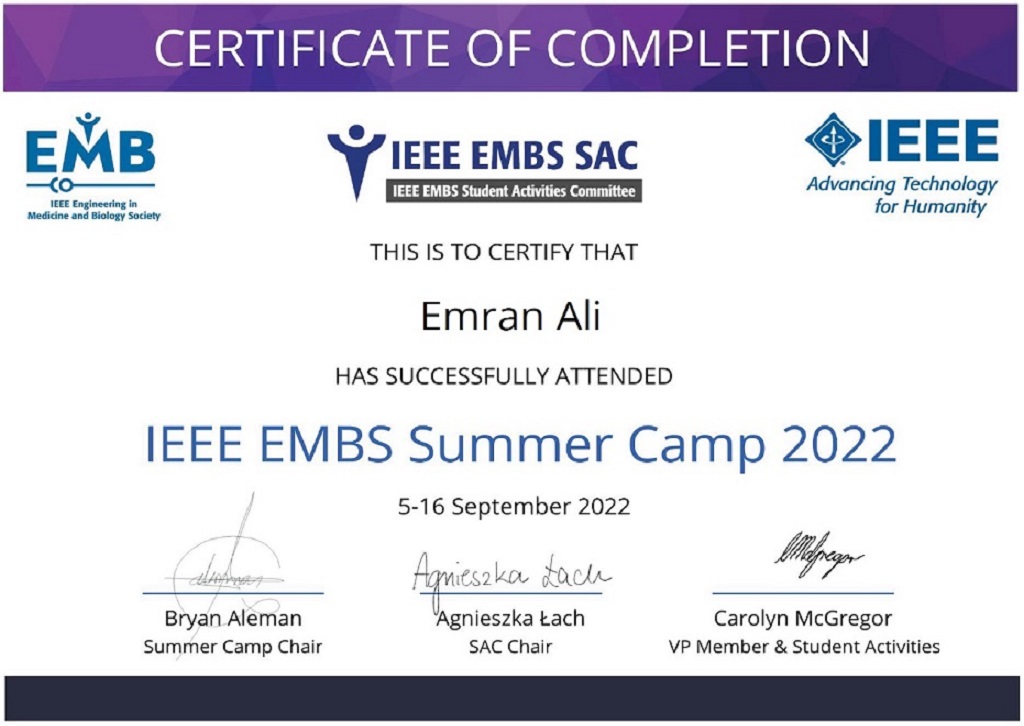
IEEE EMBS - Summer Camp 2022
Description:
Participated in the IEEE EMBS Summer Camp 2022, an intensive academic and research-oriented program focused on the intersection of engineering, medicine, and biology. The event brought together international researchers and students to explore cutting-edge topics in biomedical engineering, healthcare technologies, and interdisciplinary innovation.
Offering Organisation: IEEE EMBS - Summer Camp 2022
Funding Organisation: (N/A)
Key Information:
- IEEE EMBS - Summer Camp 2022
- EMBS Students Activities Committee
- 8 days, 24 hours
- Recent and trending research
- Healthcare, Sports, and Production industries related research
Date: Oct. 5, 2022
Link: (N/A)
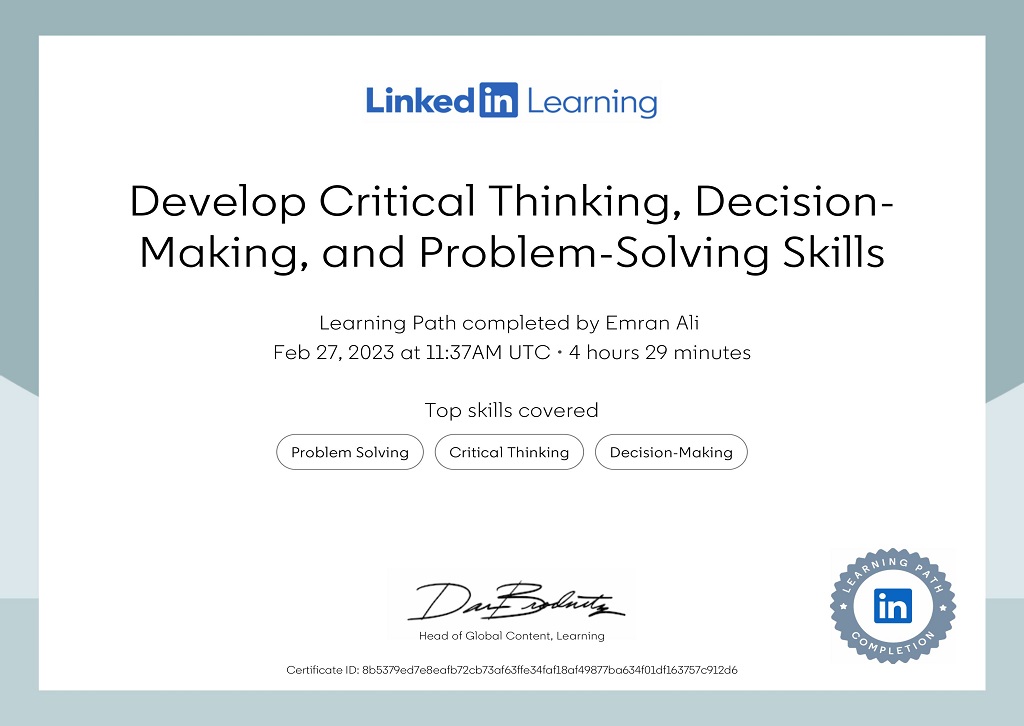
LinkedIn Learning - Develop Critical-Thinking, Decision-Making, and Problem-Solving Skills
Description:
Gain the tools to enhance your reasoning abilities, improve decision quality, and tackle problems with structured logic. This course pathway helps you:
Learn how to question assumptions and examine biases in thinking.
Break down complex problems into smaller, more manageable parts.
Apply sound logic and structured reasoning to evaluate choices.
Explore multiple perspectives to identify creative and effective solutions.
Understand the implications of data and arguments to guide strategic thinking.
Through this learning path, you'll build the confidence to approach uncertainty with a critical mindset, make better-informed decisions, and solve problems more effectively in professional and personal contexts.
https://www.linkedin.com/learning/paths/develop-critical-thinking-decision-making-and-problem-solving-skills?u=2104084
Offering Organisation: LinkedIn Learning
Funding Organisation: (N/A)
Key Information:
- LinkedIn Learning
- Self-placed learning path
- 7 courses in the learning path
- Total approximately 9 hours of learning
- Section and course wise test
Date: Feb. 27, 2023
Link: https://www.linkedin.com/learning/certificates/8b5379ed7e8eafb72cb73af63ffe34faf18af49877ba634f01df163757c912d6
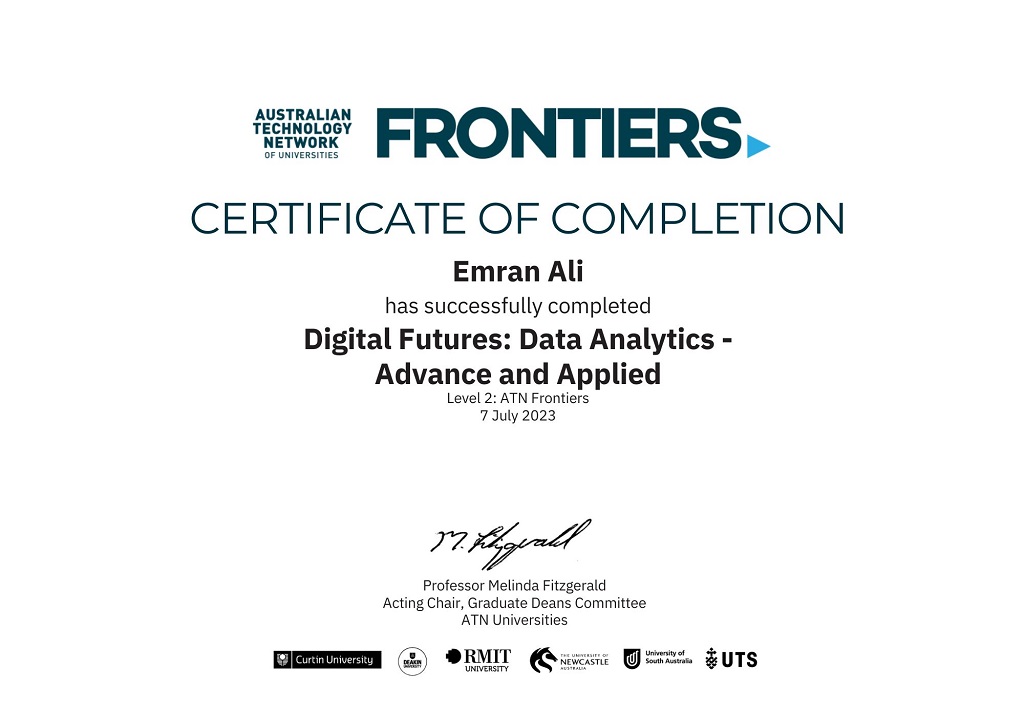
ATN Frontiers - Digital Futures: Data Analytics Advanced and Applied
Description:
In today’s data-driven world, the ability to harness and communicate insights from data is essential across diverse sectors—including STEM research, public policy, education, business, and sports. Building upon foundational knowledge from Level 1, this module focuses on advanced approaches for wrangling, analyzing, and presenting both numerical and textual data effectively.
What You Will Learn:
Use Structured Query Language (SQL) to extract, organize, filter, and summarize data from relational databases.
Apply Regular Expressions (Regex) to mine meaningful information from unstructured text sources such as spreadsheets, documents, web pages, or log files.
Explore the role of Artificial Intelligence (AI) in augmenting data analysis tasks—while critically evaluating its current capabilities and limitations.
Master the principles of data visualization and narrative storytelling to transform raw information into compelling insights.
Learning Approach:
The course combines interactive webinars, rich self-paced study materials, practical hands-on exercises, and collaborative team activities to ensure a dynamic and engaging learning experience.
Learning Outcomes:
By the end of this module, you will be able to:
Extract structured and unstructured data using SQL and Regex.
Analyze and link datasets to discover insights.
Visualize information into clear, concise, and audience-appropriate formats.
Craft and deliver data-driven stories that inform decisions and inspire action.
https://www.atn.edu.au/atn-frontiers/digital-futures/
Offering Organisation: Australian Technology Networkd of Universities
Funding Organisation: Deakin University
Date: Jul 7, 2023
Link: (N/A)
Key Information:
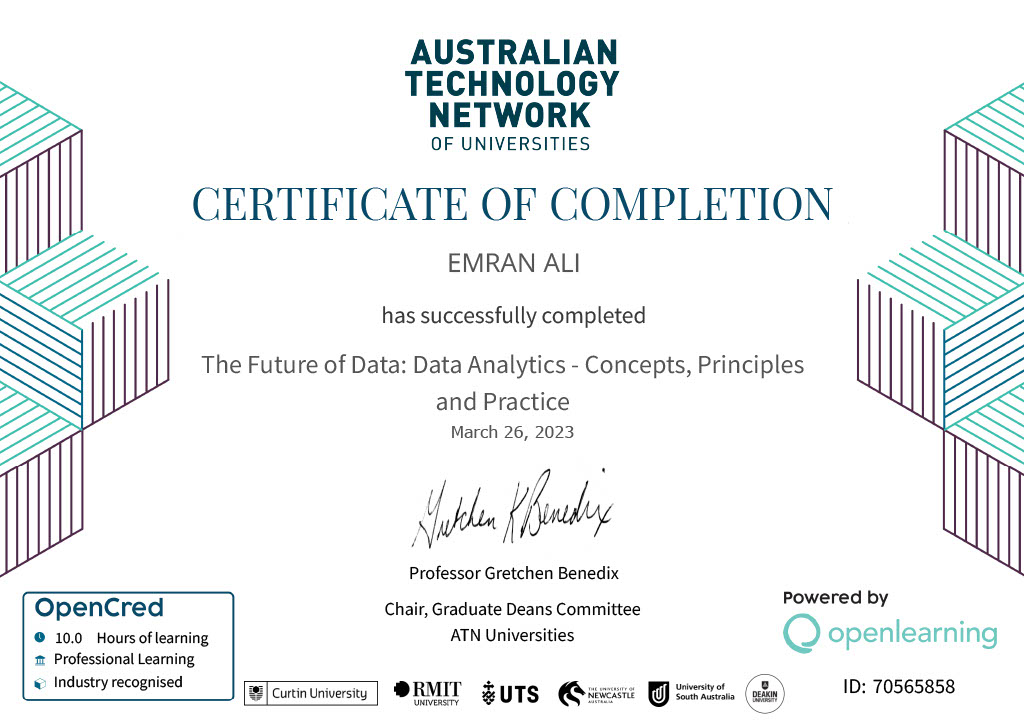
ATN Frontiers - The Future of Data - Data Analytics: Concepts, Principles and Practice
Description:
This module is designed to transform how you think, feel, and act in relation to data, preparing you to confidently navigate the demands of a data-driven professional world.
Through a structured blend of self-directed learning and interactive workshops, this course cultivates your awareness and adoption of best practices for the effective, efficient, and ethical use of data. You will engage in a curated sequence of eight topical themes delivered across a five-week learning journey:
Concepts, Drivers & Trends: Defining key ideas and principles relating to data, analytics and modelling [self-directed]
Privacy, Security, Ethics [self-directed]
Responsible Data Management [self-directed]
From Question to Data to Insights [self-directed]
Data Analytics Toolkit: Introducing principles, aids and insights for coding and analytics by syntax. [self-directed]
Start to Code: Overview and hands-on Python, markdown, Jupyter Notebooks and Kaggle. [blended: self-directed + interactive workshop]
Explore, Describe, Visualise: Convert and communicate data through graphic representation. [blended: self-directed + interactive workshop]
Tests, Models, Predict: Demonstrating basic analytical computations using the Analytics Toolkit. [blended: self-directed + interactive workshop]
Learning hours: Total of approximately 8-10 hours of learning across 4 weeks. Your learning will consist of approx. 7 hours of asynchronous online learning within the OpenLearning platform + 3 hours of synchronous learning in a series of live online facilitated workshops with your expert facilitators (dates and times in the 2024 Delivery Dates section below).
https://www.atn.edu.au/atn-frontiers/the-future-of-data/
Offering Organisation: Australian Technology Networkd of Universities
Funding Organisation: Deakin University
Date: Mar 26, 2023
Link: https://opencreds.openlearning.com/c19d0789-20db-4402-b40f-d4fe9ac777ed#gs.he0ef5
Key Information:
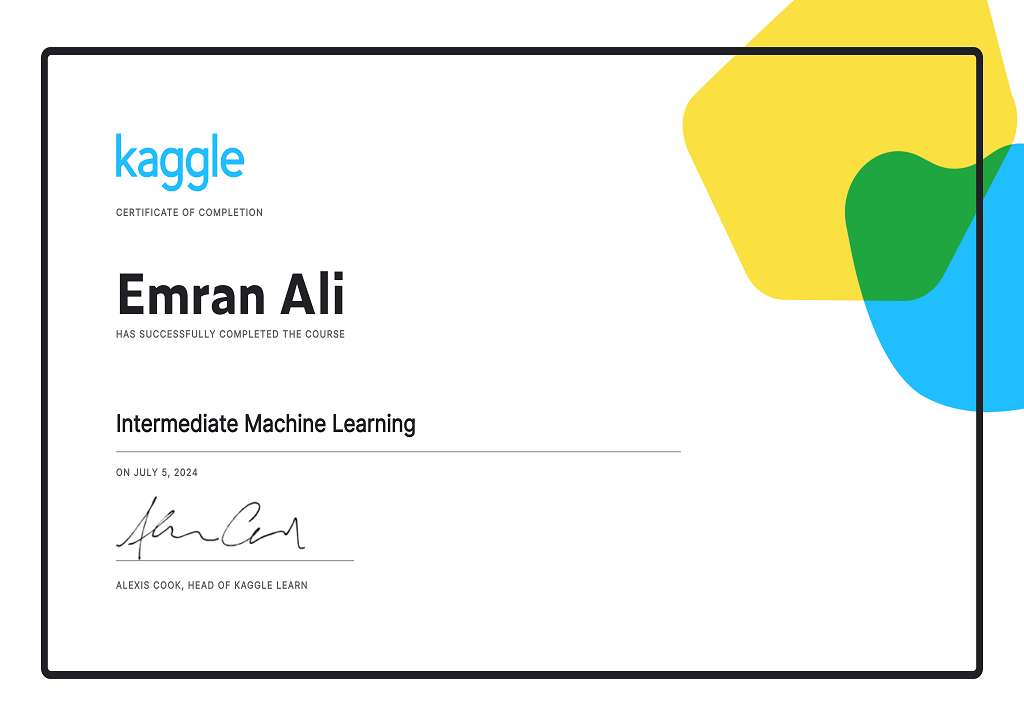
Kaggle - Intermediate Machine Learning
Description:
Intermediate Machine Learning on Kaggle helps you advance beyond basic ML by teaching how to deal with the messy, real‑world challenges that almost every dataset brings. You’ll learn how to handle missing data, manage non‑numeric/categorical features, prevent data leakage, and properly use pipelines to streamline your preprocessing and modeling workflow. The course also covers robust model validation using cross‑validation, and explores powerful algorithms like gradient boosting (XGBoost) to build accurate models for structured data. With a mix of interactive tutorials and practical exercises, the course prepares you to build reliable, production‑quality machine learning models from raw, imperfect data.
https://www.kaggle.com/learn/intermediate-machine-learning
Offering Organisation: Kaggle
Funding Organisation: (N/A)
Key Information:
- Offered by Kaggle
- 14 hours, 7 Lessons
- Lessons + hands on practice test
- Intermediate level knowledge of ML: data preparation, cross validation, XGBoost, data leackage
Date: Jul 5, 2024
Link: https://www.kaggle.com/learn/certification/wwmemran/intermediate-machine-learning
Section Leader - Code in Place 2023
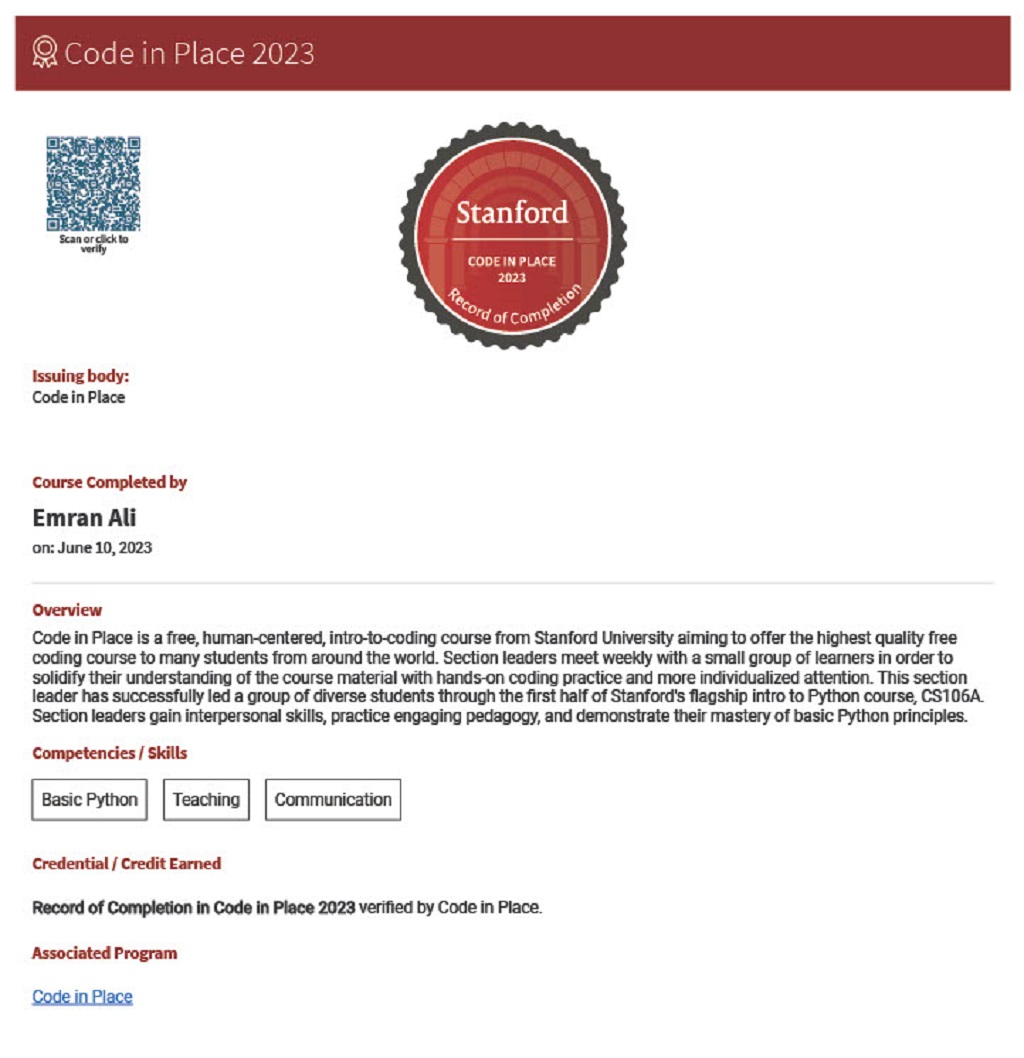
Description: CS106A is one of the most popular courses at Stanford University, taken by almost 1,600 students every year. It has been developed over the last 30 years by an amazing team, including Nick Parlante, Eric Roberts and more. The course teaches the fundamentals of computer programming using the widely-used Python programming language. This course is for everyone from humanists, and social scientists, to hardcore engineers.
What makes Code in Place special? We recruit and train one volunteer teacher for every 10 students in order to create a vibrant community of teaching and learning. We believe that the magnitude of people who want to teach computer science is large and may be roughly proportional to the magnitude of people who want to learn. Why? Teaching is joyful and teaching is the best way to learn both content and team-leading skills. We do hope this course inspires more human-centred learning for all.
https://codeinplace.stanford.edu/
Offering Organisation: Standford Online
Funding Organisation: (N/A)
Key Information:
- Offered by Standford University (online)
- 6 weeks, 1.5 hours session per week
- Instructed students to help them learn Python
- Teaching a variety of students from diverse backgrounds
Date: Apr 1, 2023
Link: https://digitalcredential.stanford.edu/check/3AB800648525EE445912F5275AE78CFDB5C8E71BB33E7E2AF5501C649FAD837EL2x5NlgxQ0txV1QzR3VjTjBSckd0YkN3SzZtbzJpOURDbXdJYmxaR3BkbW9LaGxp
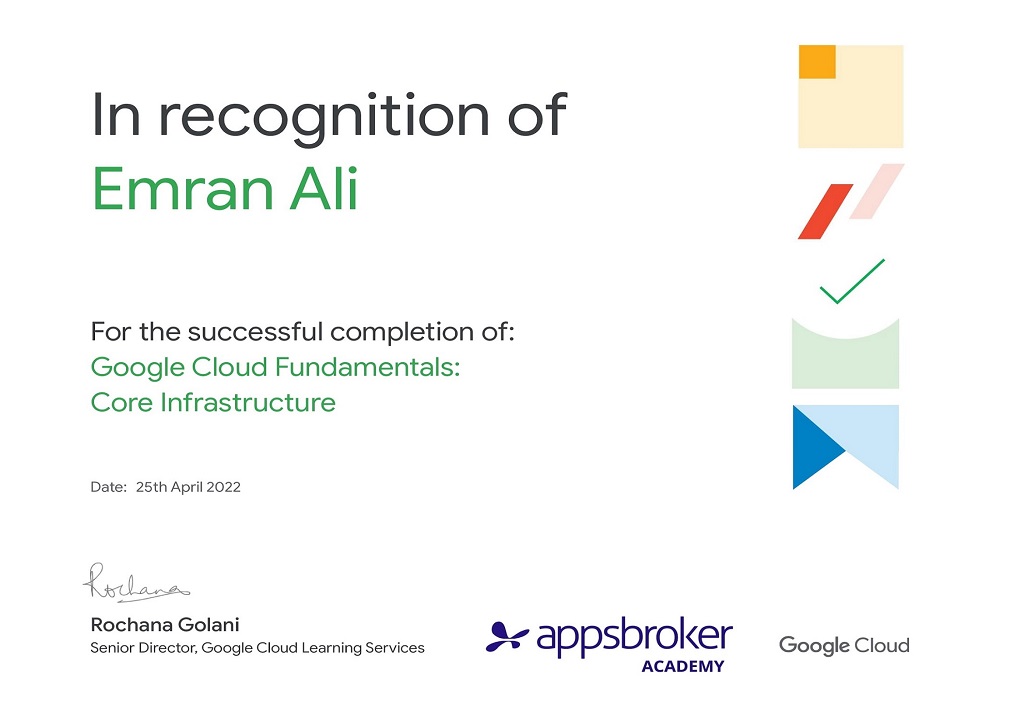
AppsBroker Academy - Google Cloud Fundamentals: Core Intrastructures
Description: (N/A)
Offering Organisation: AppsBroker Academy
Funding Organisation: (N/A)
Key Information:
- 5-hour dedicated session
- Google Cloud Fundamentals
- Google Cloud Infrastructures
- Google Cloud IaaS
- Part-wise lab and test
Date: Apr 25, 2022
Link: (N/A)
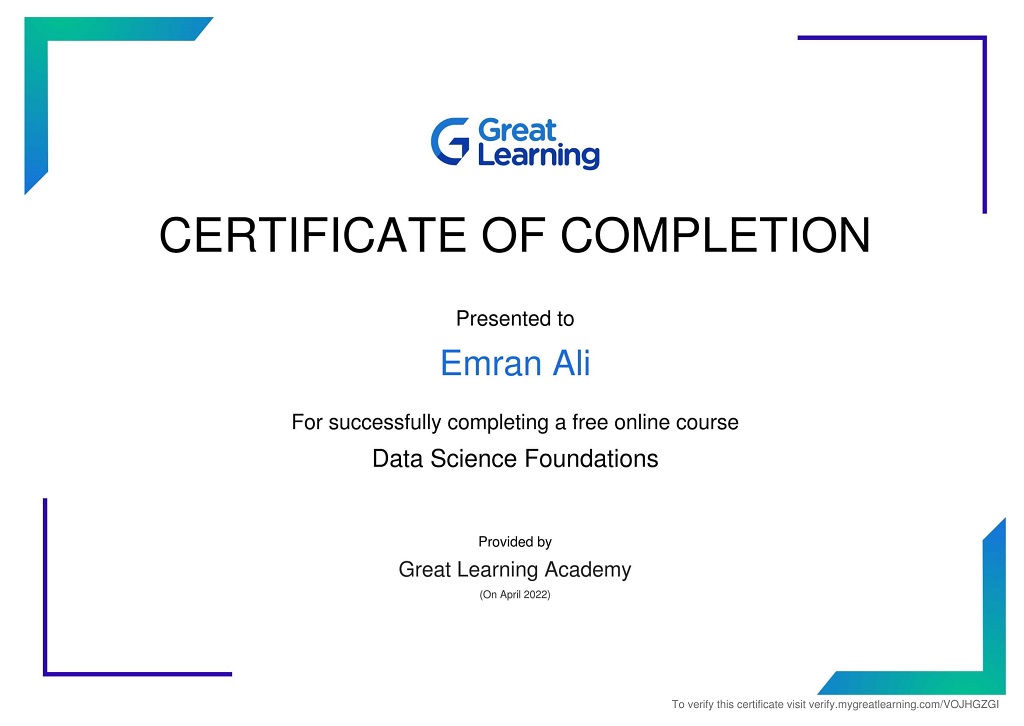
Great Learning Academy - Datascience Foundation
Description:
The Data Science Foundations course provides a comprehensive introduction to the core principles of data science and its lifecycle. It offers foundational knowledge of the major phases involved in data science projects, including data collection, cleaning, exploration, modeling, and interpretation.
Throughout the course, you will gain insights into key tasks carried out by data scientists, such as formulating analytical questions, preparing data for analysis, and deploying models. The curriculum also highlights compatible programming languages and tools used for efficient data science workflows—particularly those supporting machine learning applications.
A significant portion of the course focuses on machine learning, helping learners understand how machines derive insights from data and improve decision-making capabilities. Additionally, you'll explore the analytics landscape within organizations to understand the structure of workflows, responsibilities, and asset management practices.
The course culminates in an assessment designed to evaluate your understanding of the subject matter. You will also receive study materials and resources for continuous reference even after completing the course.
https://www.mygreatlearning.com/academy/learn-for-free/courses/data-science-foundations
Offering Organisation: Great Learning Academy
Funding Organisation: (N/A)
Key Information:
- Great Learning Academy - Free course
- Data science concepts
- Python, Numpy, Pandas
- Section-wise test
Date: Apr 1, 2022
Link: https://www.mygreatlearning.com/certificate/VOJHGZGI
Great Learning Academy - Python for Machine Learning
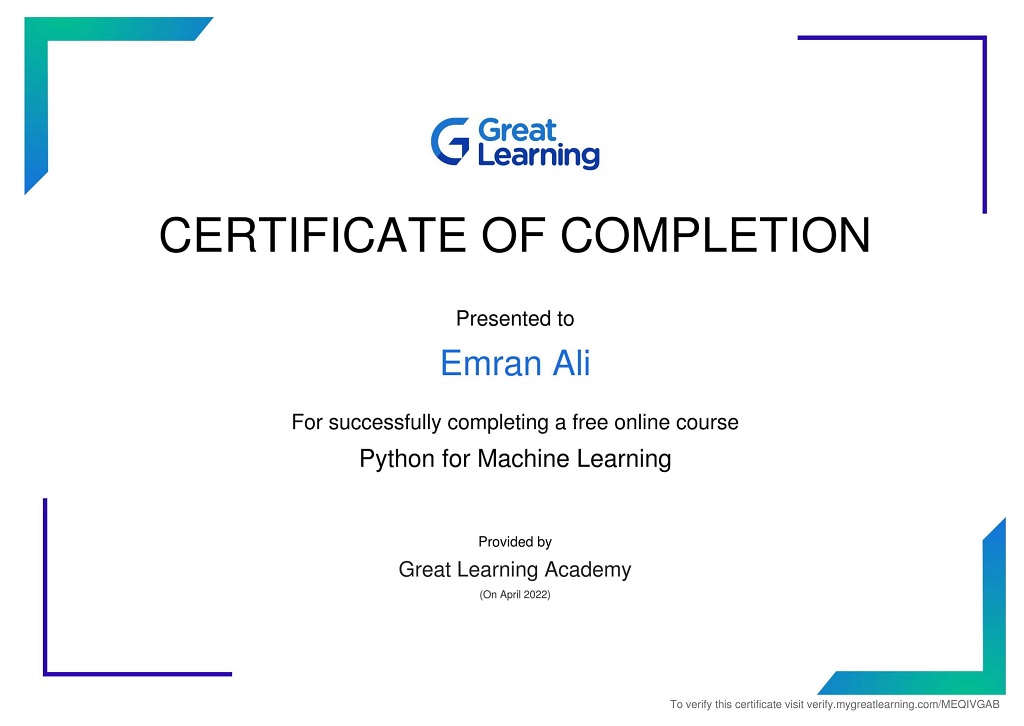
Description:
This course focuses on the key elements and features of Python programming relevant to machine learning tasks, supported by practical demonstrations.
You will begin by exploring the NumPy library, gaining an understanding of arrays, intersections, differences, and how to load and save data effectively. The course then transitions into the Pandas library, covering essential objects, DataFrames, and functions for efficient data manipulation.
https://www.mygreatlearning.com/academy/learn-for-free/courses/python-for-machine-learning3
Offering Organisation: Great Learning Academy
Funding Organisation: (N/A)
Key Information:
- Great Learning Academy - Free course
- Machine learning concepts: Data cleaning, splitting, validation; Concepts of ML models; Result evaluation, scoring
- Python, Numpy, Pandas, Scikit-learn
- Section-wise test
Date: Apr 1, 2022
Link: https://www.mygreatlearning.com/certificate/MEQIVGAB
Great Learning Academy - Machine Learning Algorithms
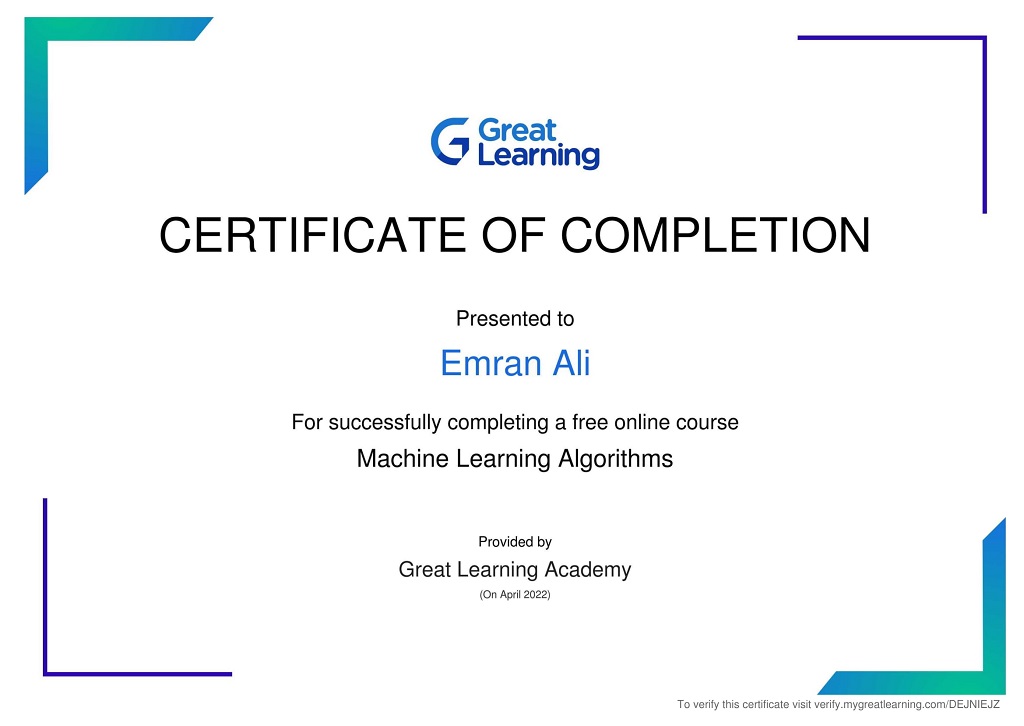
Description:
This online Machine Learning Algorithms course has been designed keeping in mind that a novice learner should be able to grasp the concepts and understand algorithms with examples.
This course covers the introduction to Machine Learning and the basics of algorithms, along with a theoretical and practical understanding of supervised, unsupervised, and reinforcement learning.
You will also gain skills to employ K-nearest Neighbor, Naive Bayes and Random Forest algorithms, and Linear Regression and Support Vector Machines (SVM) techniques to accomplish Machine Learning tasks.
A tonne of practical Python demonstrations are offered to comprehend the concepts better.
https://www.mygreatlearning.com/academy/learn-for-free/courses/machine-learning-algorithms
Offering Organisation: Great Learning Academy
Funding Organisation: (N/A)
Key Information:
- Great Learning Academy - Free course
- Machine learning models
- Classification, regression, clustering
- Section-wise test
Date: Apr 1, 2022
Link: https://www.mygreatlearning.com/certificate/DEJNIEJZ
- Great Learning Academy - Free course
- Machine learning models
- Classification, regression, clustering
- Section-wise test
Great Learning Academy - Introduction to Deep Learning
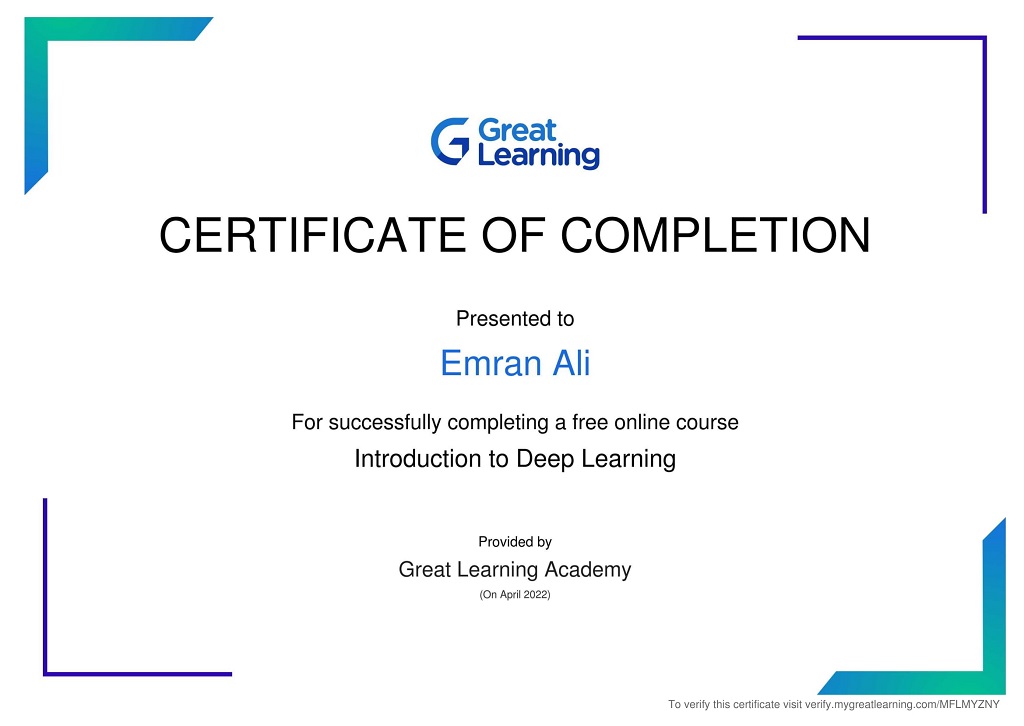
Description:
This online Introduction to Deep Learning course aims to familiarize learners with all the crucial deep learning concepts currently being utilized to solve real-world problems. You will learn about the history and applications of Deep Learning and understand the role of the second wave in DL. Also, comprehend how ML differs from DL, go through the essential terms in Deep Learning called artificial neural networks, and comprehend the Deep Learning fundamentals.
You will also go through the demo on Tensorflow Playground, CNN, and neural networks. Learn about the involvement of a basic set of layers in DL and learn about activation function and CNN. Gain knowledge regarding RNN, LSTM, types of chatbots, and conventional interfaces. Dig deeper into the concept of Deep Neural Networks and go through concepts like boolean gates, artificial neurons, Rosenblatt Neuron Perceptron, and artificial neural networks and their mechanism in detail with relevant demo and code examples.
Eager to dive deeper into the Machine Learning field? Great Learning offers Best Artificial Intelligence and Machine Learning Courses that are highly valued by our learners. Enroll in the program of your interest and earn a certificate of course completion that validates your industrial skills.
https://www.mygreatlearning.com/academy/learn-for-free/courses/introduction-to-deep-learning-1
Offering Organisation: Great Learning Academy
Funding Organisation: (N/A)
Key Information:
- Great Learning Academy - Free course
- Deep learning fundamentals
- ANN, CNN, convolution, pooling, softmax, learning. loss, back-propagation
- Section-wise test
Date: Apr 1, 2022
Link: https://www.mygreatlearning.com/certificate/MFLMYZNY
Great Learning Academy - Introduction to Tensorflow and Keras
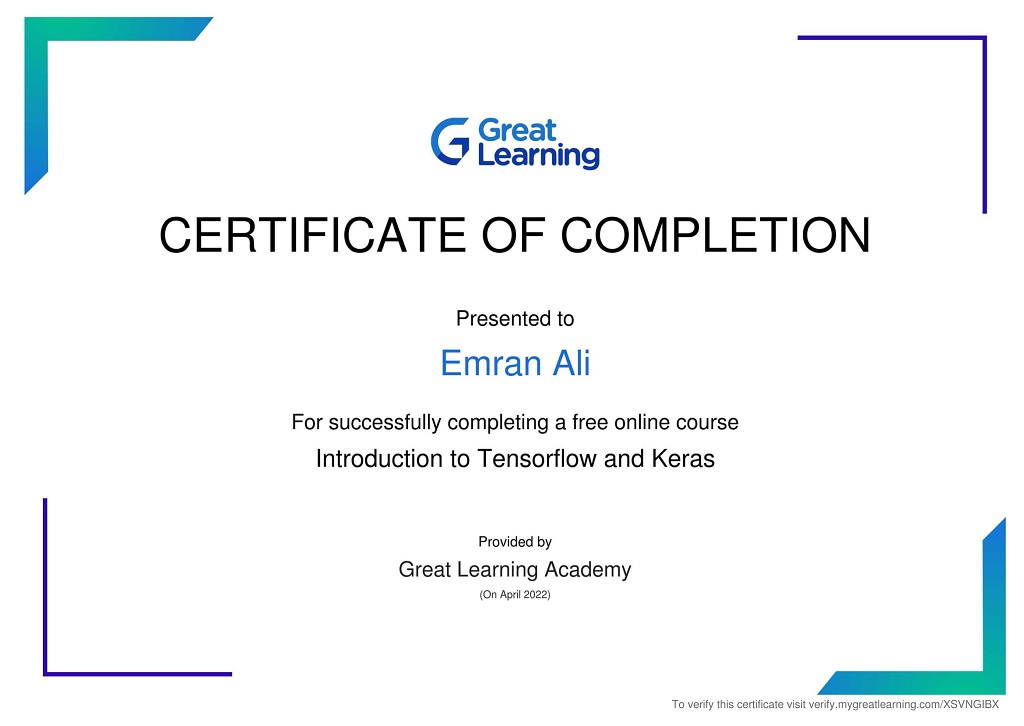
Description:
This Introduction to TensorFlow and Keras course will enrich your knowledge about all the essential Python libraries and guide you to install them step by step.
It will start by explaining what TensorFlow is and its various functionalities.
It will then take you to get a brief understanding of the prerequisites to understand tensors before moving on to the installation chapter.
Once your concept of TensorFlow is clear, the course will have you navigate through Neural Networks and discuss how you can write Tensor code to perform distinct operations.
Before wrapping up the course, you will also learn about the newer version (TensorFlow 2.x) and learn to perform Linear Regression using TensorFlow.
In the last phase, the course will take you through the hands-on session, which will discuss two use cases and finally throw light on what Keras is, its features, character recognition, and image classification using CNN.
https://www.mygreatlearning.com/academy/learn-for-free/courses/introduction-to-tensorflow-and-keras
Offering Organisation: Great Learning Academy
Funding Organisation: (N/A)
Key Information:
- Great Learning Academy - Free course
- Deep learning fundamentals; Libraries: Tensorflow, Keras
- Implementation with Keras and TensorFlow separately
- Section-wise test
Date: Apr 1, 2022
Link: https://www.mygreatlearning.com/certificate/XSVNGIBX
Intersect Australia - Data Manipulation with Python
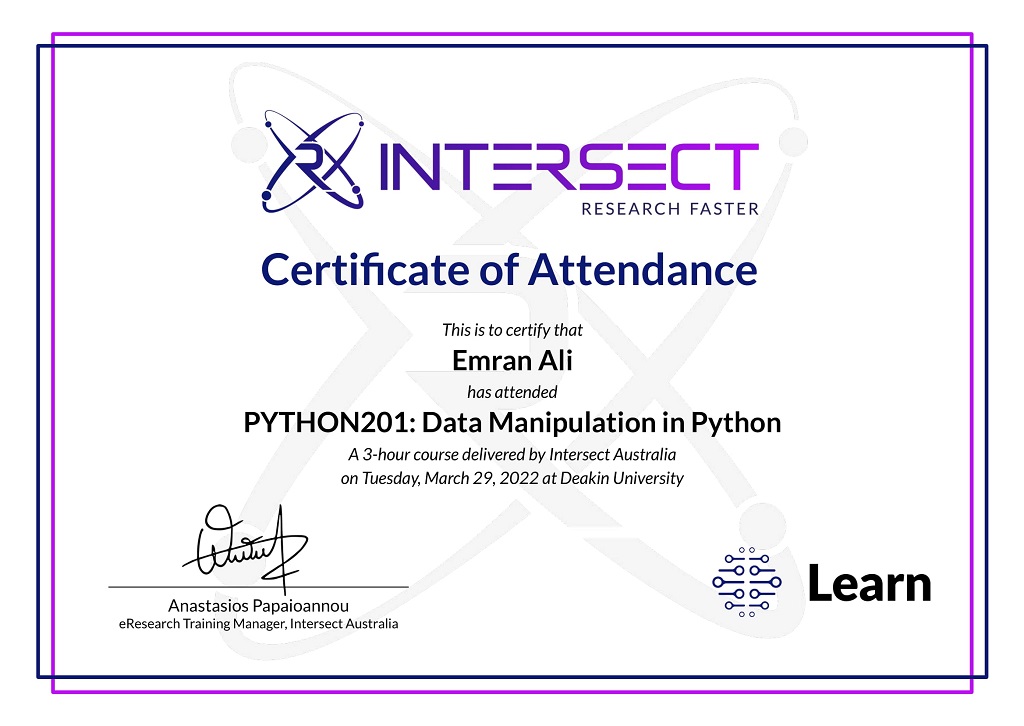
Description: (N/A)
Offering Organisation: Intersect Australia
Funding Organisation: Deakin University
Key Information:
- Intersect Australia & Deakin University collaborative training
- 3 hours
- Python, Numpy, Pandas
Date: Mar 1, 2022
Link: (N/A)
Intersect Australia - Data Visualisation with Python
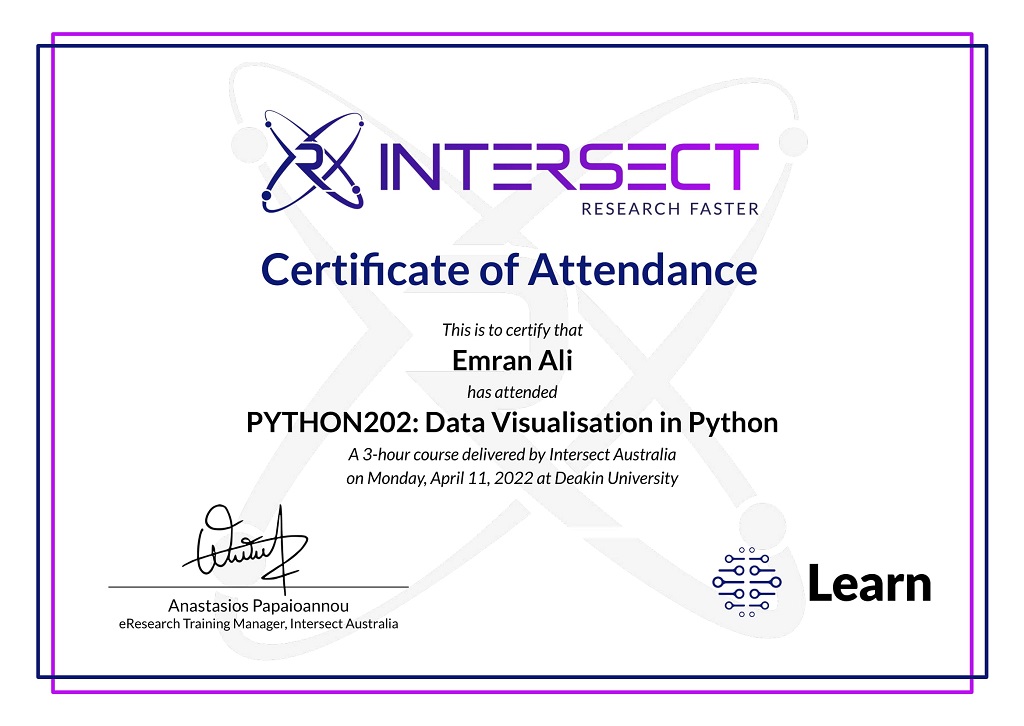
Description: (N/A)
Offering Organisation: Intersect Australia
Funding Organisation: Deakin University
Key Information:
- Intersect Australia & Deakin University collaborative training program
- 3 hours
- Python, Matplotlib, Seaborn, Fundamental and advanced graphs/plots
Date: Apr 1, 2022
Link: (N/A)